EXO-Resin™
Lightweight Structural Metamaterial
A novel metamaterial designed using AI to meet next generation requirements for rockets, missiles and other critical applications.
Arcarithm’s Artificial Intelligence and deep learning algorithms, plus a dynamic new metamaterial called EXO-Resin™, offer a rapid prototyping solution for designing components for the next generation of missiles and other critical space applications. EXO-Resin combines advanced AI with a resin-based metamaterial to quickly analyze design needs and recommend a resin/substrate formula that simultaneously tests multiple properties for dramatically reduced development time.
Material Attributes
- The base resin is extremely resistant to high temperatures.
- Any number of substrates can be added to the base resin to add new characteristics.
- Self healing.
- Structural toughness.
- EMF/Radiological resistance.
- Arcarithm AI determines the substrates and concentrations needed to meet requirements.
Rapid prototyping and component production are core characteristics of EXO-Resin. Additive and traditional manufacturing are easily incorporated in the component development process.
Component Development and Procurement Process
- Identify a component where conventional materials fall short of meeting requirements or an improved design would add value.
- Provide a spec of the desired component and performance requirements (thermal, structural, radiation tolerance).
- Arcarithm AI analyzes the requirements and provides a tailored formula of resin and substrate.
- Arcarithm provides a prototype component using the tailored resin formula for evaluation and transition to production.

EXO-Resin™ Radiological Shielding
A cutting-edge lightweight and low viscosity material tailored to address complex radiation shielding challenges. Lighter than aluminum and steel with enhanced shielding capabilities. Substrates tailored to meet exact shielding needs. Developed as multi-part shields using component 3D scan data and 3D printed molds to cast a shield that matches the targeted area exactly, limiting any chance of leakage.
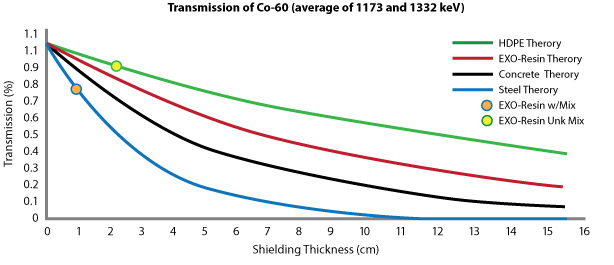
Diagram description
Title: Transmission of Co-60 (average of 1173 and 1332 keV). The chart plots transmission against shielding thickness from 0 to 16 cm. Four theoretical curves start at full transmission and fall as thickness increases. From most to least transmission they are HDPE, EXO-Resin, concrete and steel. At about 15.5 cm, transmission is roughly 0.38 for HDPE, 0.18 for EXO-Resin and 0.07 for concrete; steel reaches roughly zero by about 11.5 cm. Two measured EXO-Resin samples are also plotted at small thicknesses.
| Material | μ/p (@662 keV) | Density (lb/ft3) | HVL (in) | Weight (lb per 1’x1’) | Weight (Normalized to EXO-Resin w/Tungsten) |
|---|---|---|---|---|---|
| Pb | 0.107 | 709 | 0.23 | 13.3 | 0.89 |
| EXO-Resin (W) | 0.097 | 238 | 0.75 | 15.0 | 1.00 |
| EXO-Resin | 0.091 | 107 | 1.76 | 15.7 | 1.05 |
| Concrete | 0.079 | 144 | 1.50 | 17.9 | 1.20 |
| Steel | 0.067 | 501 | 0.51 | 21.3 | 1.42 |
EXO-Resin Properties
- WEIGHT
109.2 lb/cu ft 22% weight of INVAR 65% weight of Aluminum - Density
1.75 grams/cu cm - Dynamic Compressive Yield
26,106 psi - Coefficient of Thermal Exp.
24.1 x 10⁻⁶ in/in °F - Tensile Strength
8,412 psi - Corrosion
None - Hypochlorous Acid @ 2000 ppm - Electrical Conductivity
None (23 MegOhms) - Thermal Conductivity
Ceramic: 0.40 (W/m-K) Aluminum: 1.275 (W/m-K)
- Fire Resistant
Yes - Flexural Modulus (at 72°F)
1.305 x 10⁶ psi - Hardness, Shore “D” (at 72°F)
90 - Tensile Elongation (at break)
2.2% - Flexural Strength (at 72°F)
12,700 psi - Heat Distortion/Max Temp.
482°F / 3100°F - UV Sensitivity
None
Request A Demo of Arcarithm's AI Solutions.
Arcarithm is in the business of developing innovative solutions to solve the hardest problems. Please get in touch to learn how we can add value to your mission.
1002 Meridian Street N
Huntsville, Alabama 35801